Hive dwellers vs. screen players: The anatomy of two societies
TEHRAN – This question has puzzled many astute observers in the West — and echoed through the stunned minds of Trump and Netanyahu alike: Why, following the assassination of the leadership, did the Iranian government not collapse like governments in other countries?
In the first week, a thoughtful friend in the West posed this question to me by email. To answer it thoroughly by invoking Shia history and Imam Hussein might well prove incomprehensible to a Western mind. I therefore tried to frame my answer using concepts drawn from Western literature itself. I wrote to my friend about a book by Maurice Maeterlinck, titled *The Life of the Bee*, which a kind neighbor had gifted me in my youth, before the revolution.
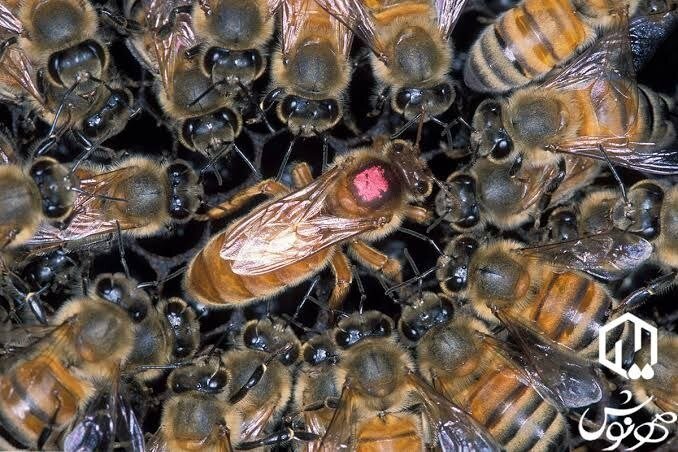
The point I am about to share may make the question easier for a Western reader to grasp. Maeterlinck notes that before a real-world experiment, all researchers assumed that the sovereign ruler of the hive was the queen, and that everything existed to serve her and her desires. They therefore designed an experiment: they placed a ring at the entrance of a beehive through which worker and soldier bees could pass easily, but which the queen, owing to her larger body, could not pass through.
They then staged a mock attack on the hive. Following their natural instinct, the bees mobilized to save the queen first. Since the only exit from the besieged hive was through that ring, the queen became stuck in it while trying to escape. After some time, her protective guards assumed she was refusing to leave. They stung her to death, selected another larva capable of becoming a queen to replace her, and established a new hive with a young queen elsewhere.
The scientist’s conclusion is profound and fascinating. From then on, he stripped the title of “God of the Hive” from the queen, redefining that supreme force as the “invisible spirit of the hive.”
This is precisely what happened in Iran, with one difference: the executioners this time were real aggressors, yet once again their violent methods failed to conquer the invisible spirit of the hive.
I will elaborate on the difference between a nation whose god is the invisible spirit of the hive and the peoples of other countries, with more precise explanations. I have a filmmaker friend named Seyyed Reza Mirkarimi, the director of several monumental works of Iranian cinema, whose name and films you can look up. He offers a striking interpretation of those countries surrounding Iran that have been independent for only a few decades. He compares them to cinematic backlots during the production of grand Hollywood epics.
To better understand his analogy, imagine a film about the era of Alexander the Great being shot on a set at Cinecitta in Rome — thousands of extras, towering props, and magnificent scenery.
Viewed from the camera angle, on the big screen, or even in IMAX, we marvel at its grandeur. Even the actors, deeply immersed in their roles through rehearsal, believe in their characters for a time. Yet once the false glamour of the screening subsides, or filming concludes, they realize they merely stepped out of their true selves for a brief spell to live in someone else’s skin.
Once shooting wraps, all those grand sets are dismantled and replaced by another set of deceptive facades. That is the sum total of a magnificent, dazzling life lived on a cinematic backlot devoid of true identity. Perhaps the very next day after filming ends, even the lead actor is not permitted to enter, wander around, or reminisce about the past.
The disparity between many newly established Arab states — filled with heterogeneous populations such as Pakistanis, Indians, and others — and the original indigenous Arab inhabitants precisely mirrors the role of these film extras. Their sole reason for being present is to collect a paycheck and grab a slice of that fleeting fame and profit for tomorrow, without leaving any lasting impact on the future of that cinematic backlot.
Yet the Iranian nation — and even the leadership that was assassinated — believes in the spirit of the hive. That is why, for two hundred and twenty days, men and women, young and old, have stood steadfastly in the public squares and streets.
In closing, I recommend that you, the reader of this essay, seek out and read the legendary Persian tale The Conference of the Birds by the Iranian poet Attar of Nishapur. The plot is briefly as follows: a flock of birds from across the world gathers to find a mythical bird named the Simurgh atop Mount Qaf and make him their leader. On the final day of the journey, atop Mount Qaf, only thirty diverse birds remain; the rest have fallen behind along the way, offering various excuses. They do not behold a mythical Simurgh; instead, they realize that the legendary Simurgh is, in fact, their own collective gathering. They no longer need to wait for a miraculous bird to lead them.