Zionist regime unable to remain in south Lebanon: Qassem
“This Resistance, which has stood steadfast, has been able to present a legend of steadfastness.”
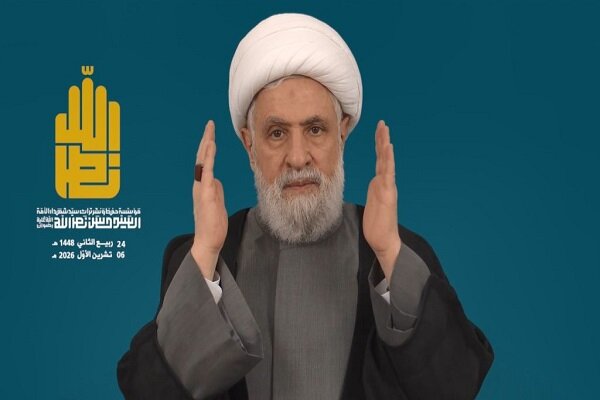
Addressing a ceremony for launching the Foundation for the Preservation and Dissemination of Legacy of late Hezbollah S.G. Sayyed Hasan Nasrallah, Sheikh Qassem said, “The steadfastness of the Resistance is among the blessings of the Master of the Ummah’s Martyrs and his guidance, as well as of this dear and pure people. We can only be a Resistance as long as aggression exists.”
“The solution begins with the enemy leaving in humiliation, along with the American who supports it with all his might in order to attack our region,” His Eminence added, “As for internal Lebanese affairs, we are ready to cooperate, but without any dictates from abroad.”
Wars unfold in rounds, but the final round belongs to the people of the land and the truth, and to those who have followed the path of the mujahideen and martyrs, Sheikh Qassem stressed.
Sheikh Qassem saluted the dear Iraqi people, their religious authority, leadership, and the Popular Mobilization Forces [Al Hashd Al Shaabi], because “they succeeded in expelling the American occupier from Iraq, and through their sacrifices and steadfastness, they were able to drive the American tyrant out of their country”.
He added: “Therefore, whether the one seeking to control Iraq is the Takfiri [forces], or the arrogant and colonial power seeking to dominate Iraq, the Iraqi people are, by the grace of Almighty God, capable of expelling the occupiers, whoever they may be and whatever their orientations, so that Iraq can remain independent, dignified, and strong.”
“The sacrifices of the Palestinian people are immense, and the Israeli, American, and Western injustice is extraordinary and unnatural. But given the nobility of this people and its sacrifices, it must emerge victorious,” Sheikh Qassem said, “I pray to Allah Almighty to grant them success in occupied Palestine, in Gaza, the West Bank, and Al-Quds, so that they may attain the highest ranks and positions, and that they may be liberated and liberate.”
Speaking on the occasion of the launch ceremony of the Foundation for the Preservation and Dissemination of the Heritage of Sayyed Hassan Nasrallah, Sheikh Qassem said: “Today, we gather under the auspices of the memory of the two noble martyrs, the two esteemed Sayyeds: the Master of the Martyrs of the Ummah, Sayyed Hasan Nasrallah, may God Almighty have mercy upon him, and the Hashemite Sayyed, may God Almighty have mercy upon him, as well as the righteous martyrs, to launch this foundation, which will be dedicated to preserving the works and heritage of the supreme martyr, Sayyed Hassan, may God Almighty have mercy upon him. Today, we announce the launch of the Foundation for the Preservation and Dissemination of the Heritage of the Master of the Martyrs of the Ummah, Sayyed Hasan Nasrallah, may God Almighty have mercy upon him.”
He continued: “This foundation was established by the Shura Council of Hezbollah and is supervised by the Secretary-General. It has a comprehensive organizational structure aimed at preserving the heritage presented by the Master of the Martyrs of the Ummah and making use of it in all cultural, social, educational, and political fields.”
He added: “This vast heritage filled the public sphere throughout the years of his life, which he devoted to obedience to Almighty God and to Islamic, jihadist, national, patriotic, and liberation work at the level of Lebanon and, indeed, at the level of the entire region.”
Sheikh Qassem noted that “Hezbollah was established in 1982, and His Eminence Sayyed Hasan, may God Almighty have mercy upon him, assumed the Secretary-Generalship in succession to the Master of the Martyrs of the Resistance, Sayyed Abbas al-Moussawi, may God Almighty have mercy upon him, in 1992, ten years after the establishment of the party.”
He explained: “The establishment had its foundations, its principles, and its men, and Sayyed Hassan was one of the men of the founding generation.”
He continued: “However, from 1992 until his martyrdom—31 years—he worked to consolidate the foundations of the Resistance, the foundations of this authentic thought, and the foundations of an orientation that would govern and influence future generations in pursuit of liberation, dignity, honor, and a virtuous and happy life in obedience to Almighty God.”
Sheikh Qassem said: “We are dealing with a very vast heritage: words, speeches, meetings, dialogues, meeting minutes, and an oral memory accumulated over this long period spanning decades. We need to collect and archive this material and make it available to researchers and the public through social media platforms, as well as through publications, books, and various works. It should also serve as material for analysis by institutions and researchers at universities and in different fields, so that they may benefit from the abundance of material presented at the intellectual and cultural levels, as well as at the political and practical levels.”
He stressed: “We are dealing with a great treasure that must be collected and made available to the public, researchers, and future generations. This is why the Foundation for the Preservation and Dissemination of the Heritage of the Master of the Martyrs of the Ummah, Sayyed Hassan Nasrallah, may God Almighty have mercy upon him, has been launched.”
Sheikh Qassem added: “On this occasion, I would like to mention some of the themes that constitute the pillars of this heritage and the foundations of this great structure, namely the structure of Hezbollah and the Resistance’s orientation in Lebanon and our region.
“First: One of the constants upon which he worked throughout this entire period was adherence to Islam and carrying the Islamic approach—the authentic Muhammadan Islam, which is concerned with cultivating the human being and providing him with a methodology that sets his life right and grants him reward in the Hereafter. Almighty God says: ‘Indeed, the religion in the sight of Allah is Islam.’ Islam excels through its methodology, its cultivation, its formation of the human being, its virtues and noble qualities, its construction of dignity, and its establishment of a happy life in this world and the Hereafter. This requires us to work according to it and to raise generations upon this great and righteous path.”
“Throughout that entire period, His Eminence Sayyed worked to highlight the concepts, ideas, and beliefs of Islam, as well as guidance and education based on Islam and the general policies upon which Islam is founded. This is extremely important, so that we understand that he was one of those who worked throughout history to preserve this approach and present it to humanity in a contemporary manner that remains consistent with the constants of this religion.”
“The second theme is education in jihad, and this is a fundamental point. Jihad is an essential principle and a foundation. In order to protect our generations, our land, our rights, and our dignity, we must struggle against the enemies, and we must confront those enemies who commit aggression for no reason other than domination and oppression, as is the case with America and Israel, as well as all enemies and colonizers who have come throughout history and may come in the future. Jihad is a fundamental principle and must be firmly established.”
“One of His Eminence the Sayyed’s distinguishing features was his strong emphasis, when addressing the issue of jihad, on the Karbala and Ashura dimension and on the leadership of Imam Hussein, peace be upon him, the undisputed Master of the Martyrs. The path embodied by Imam Hussein, peace be upon him, is the path of sacrifice in its highest form, a path that ensures the steadfastness of faith, the steadfastness of rights, and the steadfastness of the free and dignified human being.
“Likewise, in Ashura, there was Lady Zaynab, peace be upon her, who carried the banner and complemented the path of Imam Hussein, peace be upon him, within a system connected to the presence of family members, relatives, friends, and believers, conveying the message that the entire society is called upon to follow the path of Imam Hussein, peace be upon him.”
“The Master of the Martyrs of the Ummah excelled in conveying the Hussaini concept to the people and in emphasizing the commemoration of Ashura. In any case, Imam Khomeini, may God sanctify his soul, said: ‘Everything we have is from Ashura.’ The practical application of this statement was carried out by His Eminence, the Master of the Martyrs of the Ummah, Sayyed Hassan, who worked not only during the days of Ashura but continuously to encourage jihad, foster a culture of martyrdom, and educate the Ummah.”
“Thus, the path of jihad is an integrated path. We need to collect these themes and become acquainted with them, as well as with the details that he presented and upon which he educated people directly throughout these decades. This enabled us to experience in practice the true strength needed to confront challenges.
“Third: Wilayah. The third theme is wilayah. Wilayah is not something newly invented; it is a foundation and one of the principles of religion: ‘Indeed, your wali is only Allah, His Messenger, and those who believe—those who establish prayer and give zakat while bowing. And whoever takes Allah, His Messenger, and those who believe as his wali, then indeed the party of Allah will be victorious.’
“This wilayah extends from Allah to the Prophet, to Amir al-Mu’minin Ali, peace be upon him, to the Imams, peace and blessings be upon them all, to the authority of the Islamic jurist in our time, and ultimately to the handing over of the banner to Imam al-Mahdi, may God hasten his noble reappearance.”
“His emphasis on wilayah was part of this faith and part of his sincerity toward Almighty God. His emphasis on allegiance to Imam Khomeini, may God sanctify his soul, and then to Imam Khamenei, may God sanctify his soul, was an inseparable part of this integrated system, which falls under the banner of: ‘Indeed, the religion in the sight of Allah is Islam.’ It has also been proven through practical experience that this wilayah provides momentum, strength, and capability.”
“The fourth theme is the connection with Imam al-Mahdi, may God hasten his noble reappearance. His Eminence the Sayyed always spoke about the connection with Imam al-Mahdi and the Mahdist banner, and about being among the soldiers of Imam al-Mahdi, may God hasten his noble reappearance. Almighty God says: ‘And We desired to bestow favor upon those who were oppressed in the land and make them leaders and make them inheritors.’ This is one of the interpretations concerning the reappearance of Imam al-Mahdi, may God hasten his noble reappearance, and the leadership of victory at the level of humanity and the establishment of justice throughout the earth.”
“Our Sayyed always emphasized that we are living in the era of waiting, and that waiting means wilayah toward Imam al-Mahdi, may God hasten his noble reappearance; confidence in the overwhelming victory that will encompass the world; confidence in the justice that will spread throughout the world; and belief in the reappearance of the Proof, which the Lord of the Worlds, the Prophet Muhammad, peace and blessings be upon him and his family, and the Imams have promised us. This, therefore, is a fundamental matter. We need to understand the steps upon which he built his approach and through which he mobilized people.”
“The fifth theme is Islamic unity. He was extremely keen on unity between Sunnis and Shiites, as well as unity within the Shiite community, and on extending this unity to the national and broader human levels. This education and approach that he promoted was what created this broad popular support. Do you not notice how Muslims in different parts of the world love him, feel attached to him, and believe in his path and orientations? This is because he addressed them—he addressed their minds and their hearts—and appealed to sound principles.”
“Likewise, free people around the world viewed him in a positive light because he also stood with the oppressed, and this is an inseparable part of faith.
“At the domestic level, he was a patriot par excellence, standing for coexistence, the Taif Agreement, national unity, and for us to stand together: the Army, the people, and the Resistance. This is his famous formula through which he sought to make us all one bloc, one united body, in confronting external enemies, particularly the occupying and aggressor Israeli enemy that has long targeted our region. These are matters that require us to examine them and produce statements, positions, and analyses that affirm this principle.”
“The sixth and final matter in my discussion of these themes is defense and resistance. If we want to define resistance in the modern era, we can say that the first resistance figure is His Eminence Sayyed Hasan, may God Almighty have mercy upon him. Why? Because he laid its foundations, mobilized people on its basis, and worked with all resistance fighters throughout the world to create unity, connection, and interaction.
“He adopted the Resistance as a duty and a project from Imam Khomeini, may God sanctify his soul, and then from Imam Khamenei, may God sanctify his soul, and from Imam Musa al-Sadr, may God return him and his two brothers safely. In building and establishing this path, he followed the approach of Sheikh Ragheb Harb and Sayyed Abbas al-Moussawi.”
“All these are resistance paths that lead to consolidating determination, strength, and will, while ensuring the necessary means and capabilities. We must not forget in this regard the major role played by the martyred commander Hajj Qassem Soleimani, who was highly capable, influential, and a major source of support throughout the region.”
“We need to study this heritage and become acquainted with it.”
Source: Al-Manar English Website