There will be no geographical limits in confronting enemy

Rear Admiral Shahram Irani made the remarks in an interview with the Islamic Republic of Iran Broadcasting (IRIB) late on Friday, warning that any further military operations will push American forces out of the region and back to US shores.
He stated that a naval blockade is traditionally imposed before a war to pressure an adversary, but announcing one during an ongoing war amounts to an admission that the enemy has failed to achieve its military objectives.
“The enemy has not reached any of its malicious goals,” he said, adding that part of its regional presence had already been reduced and its forces had been forced to retreat.
The Navy commander said Iran’s Armed Forces successfully halted the enemy’s advance at sea, keeping it at a distance in the Arabian Sea and northern Indian Ocean.
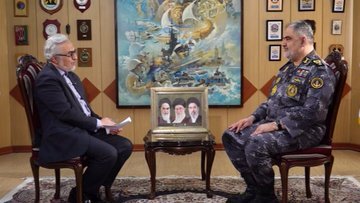
The rear admiral pointed out that the enemy had initially sought to reach Iran’s maritime zones, including its exclusive economic zone, territorial waters and internal waters, with ambitions to approach the country’s ports, coastline and islands.
However, the determination and resilience of the Iranian people and combatants, combined with close coordination between the Army’s Navy and the Islamic Revolutionary Guards Corps (IRGC) Navy, had thwarted those plans.
Rear Admiral Irani said the enemy was now reduced to seeking permission to pass through the Strait of Hormuz, while its advance toward Iran had been stopped.
The Navy commander said the enemy was attempting to cut off Iran’s economic lifeline through various measures and changing labels for its blockade efforts.
“Thanks to the assistance of the Almighty God, this strategic passage is underway, and our ports are active today,” he said, according to IRNA.
He also paid tribute to Iranian sailors, shipping crews and oil tanker workers, saying they were working around the clock to keep maritime activities going.
Irani stressed that the Navy remained alongside the country’s seafarers and was closely supporting their efforts.
He said Iran’s armed forces continued to exercise control over the maritime battlefield and would maintain their position with strength.
The Navy commander said new directives had been issued to the armed forces, stressing that Iran would no longer be bound by geographical restrictions in carrying out its missions.
He said the directive, issued by the Supreme Commander-in-Chief, meant Iran’s response could extend beyond previously defined areas.
Irani warned the enemy that Iran would continue to strengthen its military capabilities and respond to hostile actions.
He also vowed that Iran would avenge the sailors killed aboard the Dena destroyer, saying the enemy violated international rules and maritime conventions.
The Navy commander said Iran’s operation against the US Fifth Fleet base in Bahrain involved all branches of the country’s armed forces.
He said the base’s command-and-control system had been severely damaged, forcing US forces to relocate parts of their command structure to the occupied territories and naval vessels.
Irani said the operation involved the Army and IRGC navies, the Air Force, the Aerospace Force and the Ground Forces.
He said the enemy had believed it could direct the battlefield from close to the theater of operations, but Iran’s strikes had disrupted that capability.
MNA